Getting Hip to Type
Consider the following snippet from a newsletter recently published by a Big Law firm:

Consider the first sentence under the head:
Companies and individuals are becoming increasingly conscious of their carbon footprint—a measure of carbon dioxide emissions, which are believed to contribute to global warming, attributable to their activities.
And note the use of a single em dash to set off the parenthetical expression (i.e., a measure of carbon dioxide emissions, which are believed to contribute to global warming).
The problem here is that an editor didn’t bother to review this newsletter before it was published. Had an editor reviewed this, an old rule would surely have been applied: one to separate; two to enclose.
If you’re going to set off a parenthetical with commas or dashes (the preferred method), you need two. One won’t do, because readers might be left wondering where the parenthetical ends, and the main clause resumes.
In this case, simply replacing the closing comma with a dash won’t do. No . . . this snippet needs a bit more care than that.
Why? Because a parenthetical is something that can be omitted without altering the meaning of the sentence. Here’s that sentence without the parenthetical:
Companies and individuals are becoming increasingly conscious of their carbon footprint attributable to their activities.
I’m sorry, but that just doesn’t read very well (even when the singular/plural disagreement is resolved.)
So . . . what would a skilled and experienced editor do with this snippet? Something like this:
Companies and individuals are becoming increasingly aware of their carbon footprints, the amount of carbon dioxide — now widely believed to be a major factor in global warming — that is produced by them, or on their behalf.
It’s not great, but it does obey all the rules (although it uses artistic license to claim that companies — abstract entities that they are — can be aware of anything.)
Note: The original scores 2.3 on Flesch Reading Ease, a common measure of readability ; the edited version scores 26.9, a notable improvement, and one that — if applied consistently throughout the newsletter — would help it attract a larger audience.
____________
Notice something else about the snippet. It’s set in Univers, a face quite similar to Helvetica in both form and function.
Univers:
![]()
Helvetica:
![]()
Univers and Helvetica are display faces. They’re for use in heads, captions, and call-outs, not body copy.
So . . . why set a nine-page newsletter in a sans-serif face like Univers?
One could argue that the newsletter was meant be read on-line, and that a sans-serif face offers the best readability on computers and mobile devices. But the newsletter — a PDF file — was meant for print.
How can I tell? Take a look at the alert in question. Do you see any interactive elements?
Notice the two e-mail addresses at the bottom of the first paragraph. You can’t click either one to contact an editor. Had this been designed to be viewed on-line, you could.
Also, notice the excessive leading used for the body copy. The type is 10-pt Universe-Light but there’s 16 points between lines, rather than 12.
Now, go to a newsstand. Notice that just about every paper and magazine there is set 10 on 12. Go to a bookstore. The same thing: 10 on 12 in just about every book there. There must be some reason why 10 on 12 is so popular, and 10 on 16 is only used for short amounts of copy in marketing brochures and print ads.
____________
There’s something of a debate in the type world about the use of sans-serif faces for body copy, and it betrays a generational divide.
Some new sans-serif faces are very readable, and they’re ideal for publications displayed by device, rather than printed on paper. But, this simple fact remains: when it comes to printed copy, serif faces are more readable than the sans-serif faces, and the pros know this.
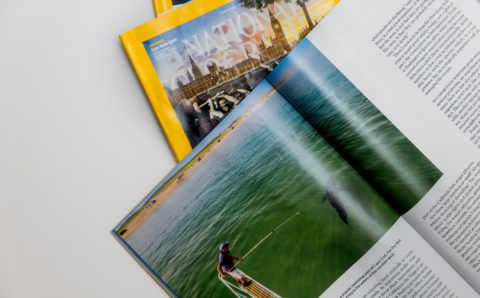
Pick up a popular magazine published by a reputable source. Grab a newspaper. Go to the bookstore and start browsing the best sellers.
Notice that almost all use serif faces for body copy, and for good reason. If you design or produce newsletters or client alerts or just about anything of substance for a law firm, you should be hip to it.
If you’d like to learn more, check out this article, published by Adobe Systems, by folks who know a thing or two about type.